See Starlink tonight, from your backyard
Enter your ZIP code: we compute when Starlink satellites and the International Space Station cross your dark sky over the next three nights, where to look, and whether a fresh Starlink train is up.
Free · no sign-up · live orbital data
Orbits are computed in your browser: your device location is never sent to us, and a ZIP code is only used to look up its center point. We store neither. Times are shown in your device's time zone (UTC).
How to actually spot them
Satellites don't make their own light. You see them because they reflect sunlight while your patch of ground is already in darkness. That only happens for a while after sunset and before sunrise; in the middle of the night, Earth's shadow swallows most low satellites. That is why the tool above gives you a window, not a whole night.
- Get away from streetlights and give your eyes 15 minutes to adjust. Your phone screen resets that, so dim it.
- Face the direction the tool gives you and look about halfway up the sky. Starlink satellites move faster than you expect, crossing in a few minutes.
- Steady light, straight line, no sound: satellite. Blinking red and green: plane.
- The ISS is much brighter than any Starlink satellite and needs no dark site at all. It is the easiest one to start with, even from a city.
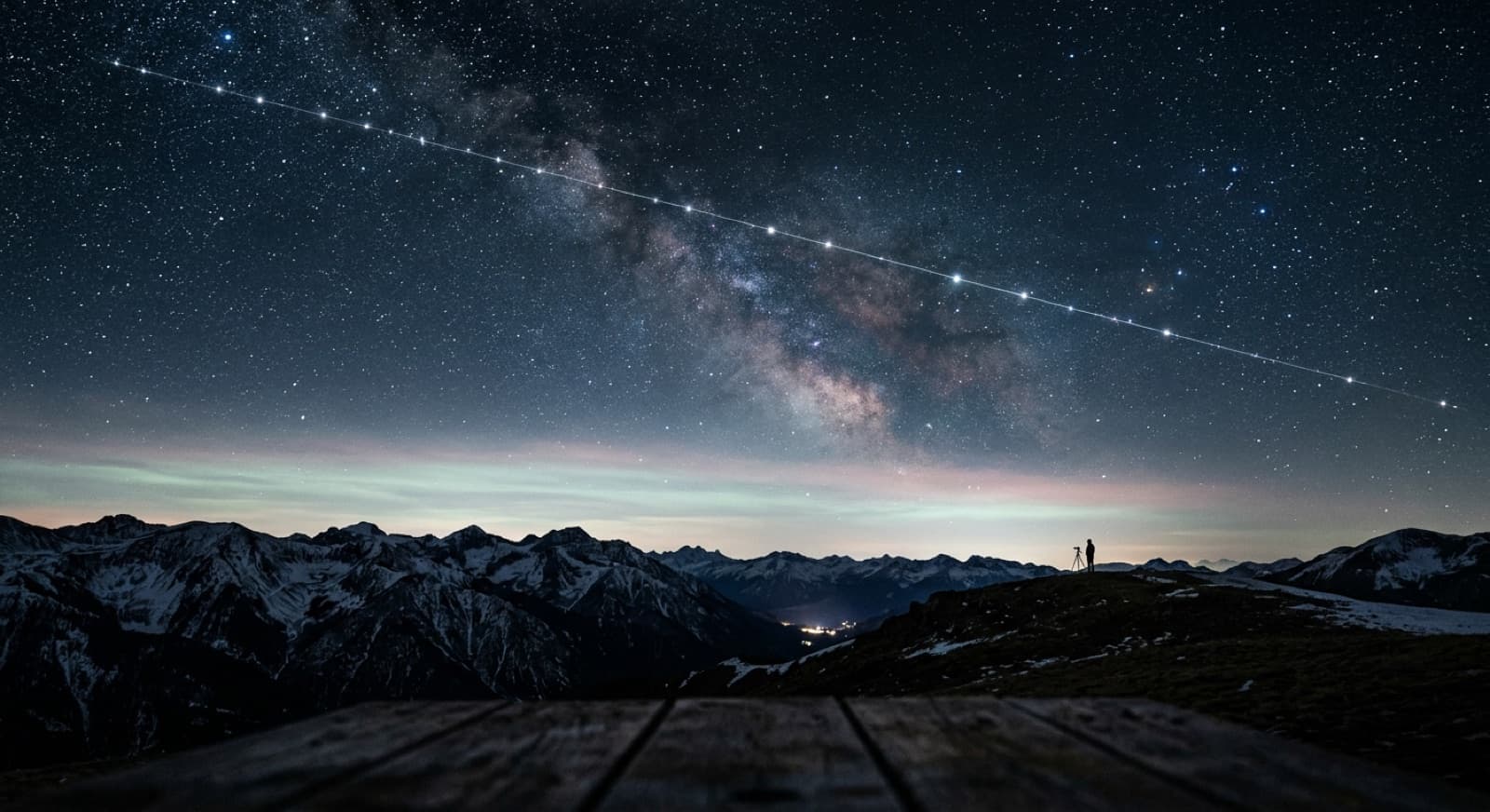
Why the trains are rarer now
In 2019 and 2020, newly launched batches stayed bunched up for weeks and drew bright lines across the sky. Recent batches spread out sooner, and SpaceX has made newer satellites reflect less sunlight. A train is still visible right after a launch, but the window is short. The tool checks the latest catalog every few hours and shows a train as soon as one is bunched up and crosses your dark sky.
See them all at once
The satellites you spot are a tiny slice of the network. Our live 3D map shows every Starlink satellite in orbit right now, and if you are here because you own a dish, the Starlink Mini battery calculator and dated plan comparison are the most used pages on the site.
Questions people ask
Can I see Starlink satellites tonight?
Usually yes, from a dark spot, in the first one to two hours after dusk or before dawn. That is when the sky is dark where you stand but sunlight still reaches satellites 300 miles up. Enter your ZIP code above to get the best window for your location tonight.
What is a Starlink train?
Starlink satellites are launched in batches of around 20 to 30. For a few days after a launch they fly close together in a straight line, which looks like a string of moving lights. As they climb to their working orbit they spread out and the train disappears. This page flags a train automatically whenever a fresh batch is still bunched up.
Why can't I see the Starlink train anymore?
Trains only last a few days after each launch. Once the satellites separate and raise their orbits, each one is a faint single point. Newer Starlink satellites are also designed to be dimmer, so outside of a fresh train you need dark skies to spot them.
What do Starlink satellites look like in the sky?
Like dim stars moving in a straight line at a steady pace, with no blinking lights. Planes blink and make noise; meteors last a second. A satellite takes several minutes to cross the sky and can fade out in mid-sky when it enters Earth's shadow.
How accurate are these times?
Within about a minute. We use the latest public orbital elements from CelesTrak and the standard SGP4 model, refreshed every few hours. The ISS sometimes fires its engines to raise its orbit, which can shift passes slightly, so check again on the day.
Is this an official Starlink or NASA tool?
No. SatPicker is independent and not affiliated with SpaceX, Starlink or NASA. The predictions are computed in your browser from public orbital data. If you use your device location, it is never sent to our server.