Starlink Mini Solar Setup: What Size Panel and Battery?
How many solar watts and battery watt-hours keep a Starlink Mini online off-grid, with worked examples for summer and winter sun.
Updated October 26, 2026 · By the SatPicker team
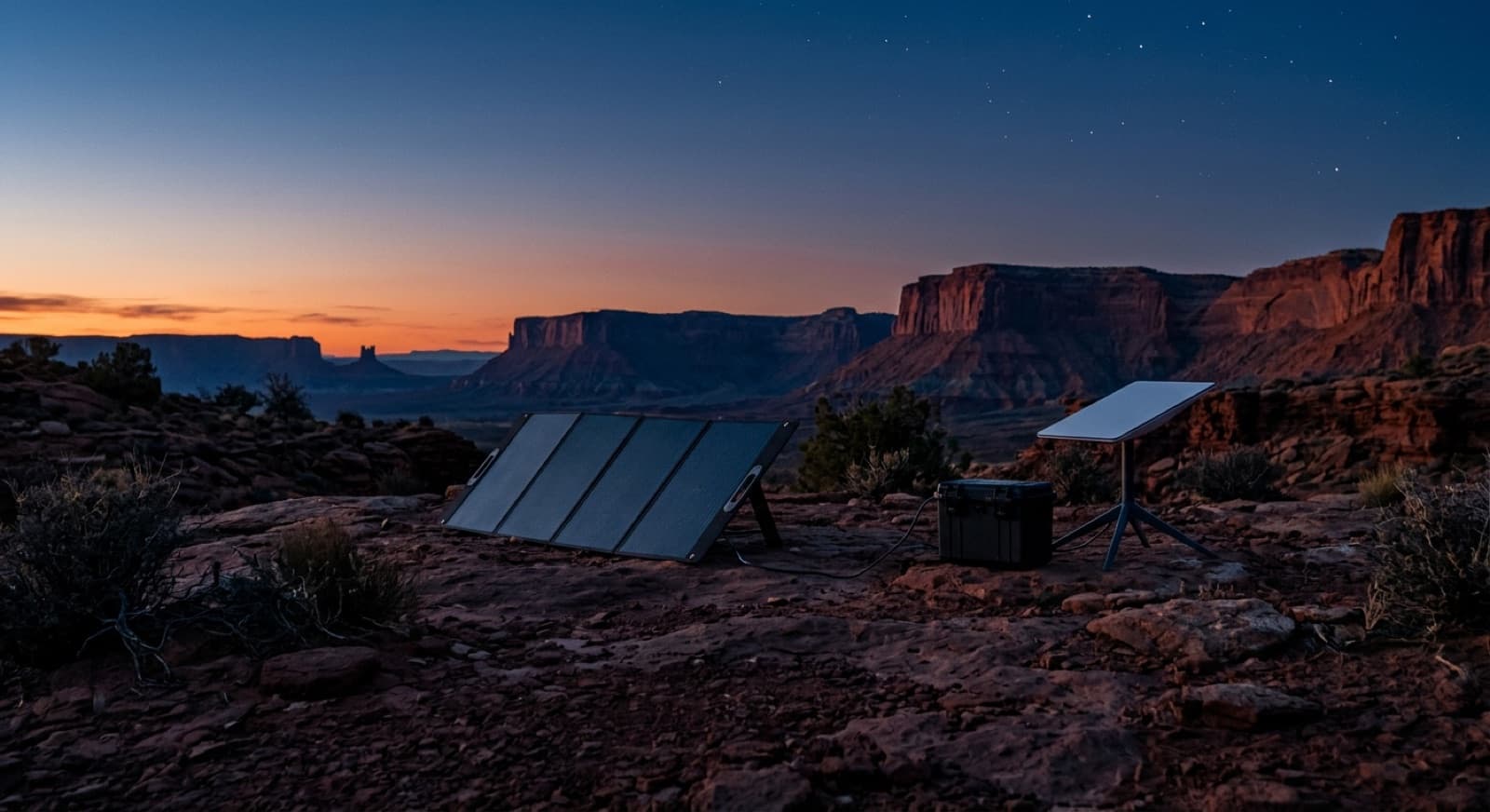
In short
A Starlink Mini plus a decent panel is the setup that finally makes long off-grid stays work: a week at a desert BLM spot, a cabin with no utility line, a sailboat on a mooring. Undersize either side and you spend your evenings watching the battery percentage instead of your movie. The math is not hard, and it takes about five minutes to get right.
Step 1: your daily energy need
Starlink rates the Mini at 25–40 W on average. Multiply your average draw by the hours it is on, then divide by 0.9 to account for the losses of a DC connection (USB-C PD or 12 V). Through an AC inverter, divide by 0.8 instead.
| Use per day | 25 W avg | 30 W avg | 40 W avg |
|---|---|---|---|
| 4 hours | 111 Wh | 133 Wh | 178 Wh |
| 8 hours | 222 Wh | 267 Wh | 356 Wh |
| 12 hours | 333 Wh | 400 Wh | 533 Wh |
| 24 hours (always on) | 667 Wh | 800 Wh | 1,067 Wh |
Be honest about the hours. Many people leave the dish on all day "just in case". If you only need it for a morning of work and an evening of streaming, switching it off in between cuts your solar needs in half.
Step 2: what your panel really produces
A panel's rating is a lab number. On a roof or a camp chair, expect less. We plan with 75% of the nameplate wattage multiplied by the peak sun hours of your location and season.
| Panel | 2.5 sun hours (weak winter day) | 4 sun hours (average) | 6 sun hours (strong summer day) |
|---|---|---|---|
| 100 W | 188 Wh | 300 Wh | 450 Wh |
| 200 W | 375 Wh | 600 Wh | 900 Wh |
| 400 W | 750 Wh | 1,200 Wh | 1,800 Wh |
Peak sun hours vary enormously with latitude, season and weather. The Southwest in June is a different planet from the Pacific Northwest in December. For a real figure for your area, use a solar resource tool such as NREL's PVWatts, then plug it into our calculator.
Step 3: the battery bridges the night
Solar only works in daylight, so the battery carries you through the evening, the night and the cloudy days. A simple rule: the battery's usable energy should cover at least one full day of use, plus one extra day for every cloudy day you want to ride out.
With our method (90% of rated capacity usable), rated capacity = daily need × days ÷ 0.9. Worked example for 8 hours a day at 30 W:
- Daily need: 30 × 8 ÷ 0.9 ≈ 267 Wh.
- One day plus one cloudy day: 534 Wh usable.
- Rated capacity: 534 ÷ 0.9 ≈ 593 Wh, so a unit in the 600–700 Wh class.
For a breakdown of power station sizes and the ports you need, see how to size a power station for the Mini.
Three setups that work
| Scenario | Daily use | Panel | Battery |
|---|---|---|---|
| Weekend camping, work in the morning | 4 h at 30 W (≈133 Wh) | 100 W portable | 300–500 Wh |
| Full-time van life, workday plus evening | 8–10 h at 30 W (≈267–333 Wh) | 200 W roof | 600–1,000 Wh |
| Off-grid cabin or boat, always on | 24 h at 30 W (≈800 Wh) | 300–400 W | 1,500–2,000 Wh |
These assume the Mini is the only load and around 4 peak sun hours. Add your laptop, fridge or lights to the daily need before sizing anything. Winter in the north may need double the panel.
Installation details that cost people hours
- Use a charge controller. Built into most power stations; for a separate house battery, an MPPT controller gets more out of the panel than a basic PWM unit, especially in cold weather and partial light.
- Check the solar input limits. Power stations accept a maximum wattage and a voltage window. Panels wired in series can exceed it.
- Angle beats size in winter. A flat roof panel loses a lot when the sun is low. A tiltable portable panel can outperform a bigger flat one from November to February.
- Place the dish and the panel separately. The Mini needs a wide, unobstructed view of the sky (the Starlink app's obstruction check shows you where); the panel wants direct sun. The best spot for one is rarely the best for the other.
- Mind the cold. The Mini is rated down to −22 °F, but most lithium batteries should not be charged below freezing. Keep the battery inside.
Should you run the Mini on DC from the solar battery?
Yes, whenever you can. A 12 V or USB-C PD connection uses about 10% less energy than going through an inverter and the power supply. That is 10% less panel for the same result. Our 12 V guide covers cables, fuses and the 100 W USB-C requirement.
Once the power side is sorted, the remaining cost is the plan: Roam plans are built for this kind of use. Compare them on our Starlink plans page.
Frequently asked questions
What size solar panel do I need for a Starlink Mini?
For about 8 hours of use a day at a 30 W average, the Mini needs roughly 270 Wh per day on a DC connection. A 100 W panel covers that with about 4 peak sun hours; a 200 W panel covers it with margin, and still produces enough on a weaker winter day with around 2.5 peak sun hours.
Can I run the Starlink Mini directly from a solar panel?
Not reliably. Panel output swings with clouds and sun angle, and the Mini needs a steady 12–48 V source able to deliver 60 W. Put a battery (or a power station) between the panel and the dish, with a charge controller.
Can solar keep a Starlink Mini running 24/7?
Yes, with enough panel and battery. Running all day at a 30 W average uses about 800 Wh per day on DC. That takes roughly 270 W of panels at 4 peak sun hours, and a battery big enough to cover the night and a cloudy day.
What are peak sun hours?
The number of hours per day the sun would deliver 1,000 W per square meter if it shone at full strength. It folds in season, latitude and weather. It varies a lot by location and time of year, so look up your area with a solar resource tool such as NREL's PVWatts.
Why do you count only 75% of the panel's rating?
Real panels rarely deliver their nameplate wattage: heat, dust, angle, wiring and charge controller losses all take a share. 75% is a conservative planning figure; well-angled panels in cool, clear weather can do better.
Free tool
Starlink Mini battery & solar calculator
Enter your battery, panel watts and sun hours to see how many days you can stay off-grid.
SatPicker is independent and not affiliated with SpaceX or Starlink. Specs come from Starlink's official specification sheets; prices are dated and can change — your Starlink checkout is the final word.