Best Power Station for Starlink Mini: How to Size It (2026)
How many watt-hours the Starlink Mini really needs, which output ports matter, and how to pick a power station without overpaying.
Updated October 26, 2026 · By the SatPicker team
In short
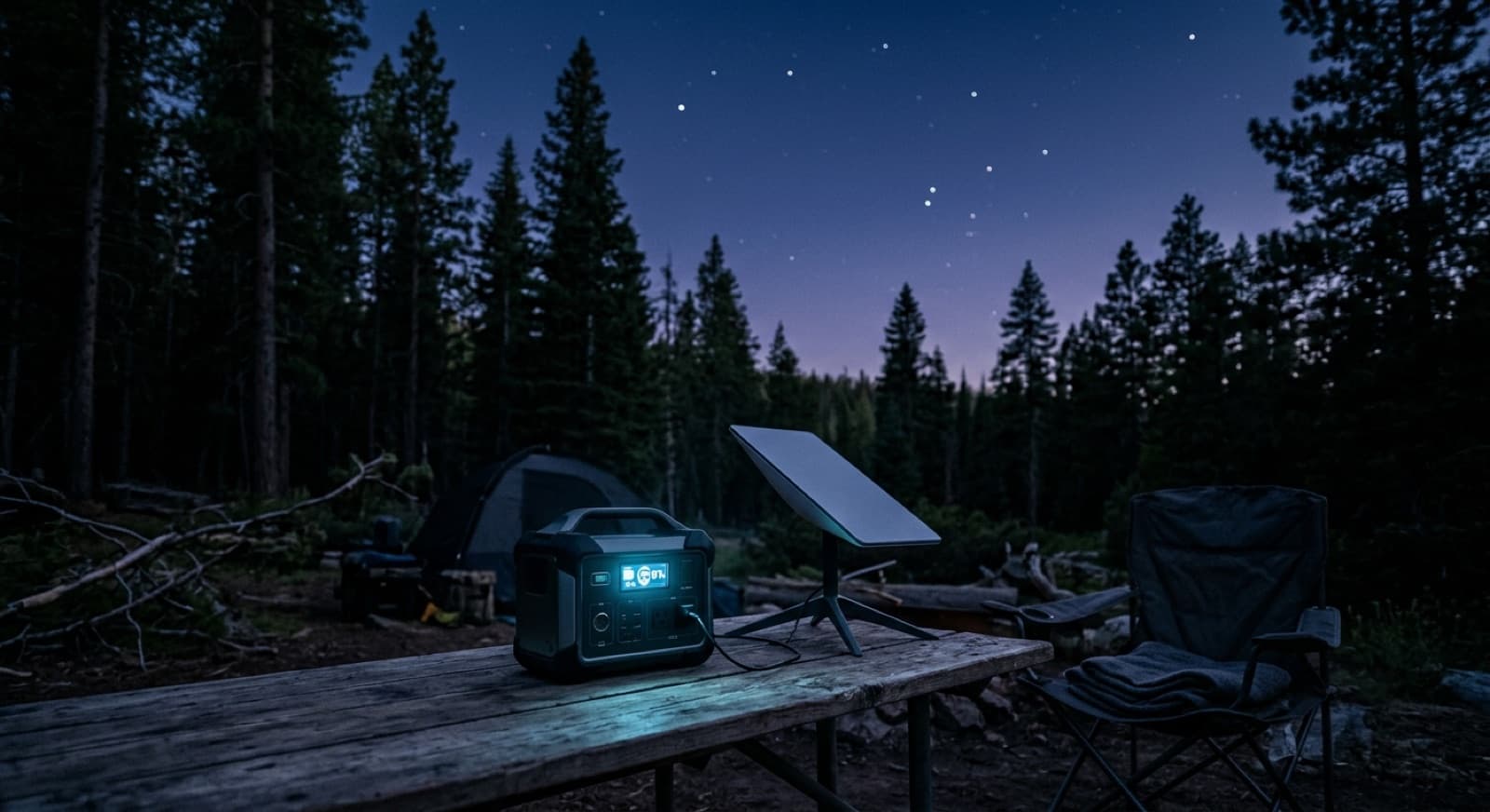
Short version: buy watt-hours for the hours you actually spend online, then make sure the box has the right port. Most power station ads talk about phone charges and laptop cycles, which tells you nothing about a dish that sips 30 W all day. Here are the numbers that decide whether the Mini stays up through a Zoom call at a trailhead or dies at 2 a.m. in the campground.
What the Starlink Mini actually draws
Starlink's specification sheet for the Mini gives three numbers that matter for battery sizing:
- Average consumption: 25–40 W. Light browsing sits at the low end; video calls, streaming, heat and a crowded sky push it up.
- Input: 12–48 V DC, 60 W. The dish can be powered directly from a DC source in that voltage range able to supply 60 W.
- USB-C PD requirement: 100 W, 20 V / 5 A minimum, using Starlink's USB-C cable accessory (sold separately).
The average is what drains your battery. The input rating is what your power station's port must be able to deliver, because the dish can briefly pull more than its average at start-up and when its snow-melt mode is active. Size the port for the average instead of the rated input and you get the classic symptom: a Mini that reboots every time it gets busy.
For context, the full-size Starlink Standard kit averages 75–100 W, roughly two and a half to three times the Mini. If you are still choosing between the two, read Starlink Mini vs Standard first.
How to calculate run time
Power station capacity is sold in watt-hours (Wh). You never get all of it, for two reasons: the battery management system keeps a reserve, and every conversion loses some energy. We use the same conservative method in our calculator:
- Usable capacity = 90% of the rated capacity.
- Efficiency = 90% on a DC path (USB-C PD or 12 V DC), about 80% through the AC inverter and the original power supply.
Run time (hours) = rated Wh × 0.9 × efficiency ÷ average watts.
Worked example: a 1,024 Wh power station feeding a Mini that averages 30 W over USB-C PD:
1,024 × 0.9 × 0.9 ÷ 30 ≈ 27.6 hours. Through the AC outlet instead: 1,024 × 0.9 × 0.8 ÷ 30 ≈ 24.6 hours.
Run time by power station size
| Rated capacity | 25 W avg (DC) | 30 W avg (DC) | 40 W avg (DC) | 30 W avg (AC) |
|---|---|---|---|---|
| 256 Wh | 8.3 h | 6.9 h | 5.2 h | 6.1 h |
| 512 Wh | 16.6 h | 13.8 h | 10.4 h | 12.3 h |
| 1,024 Wh | 33.2 h | 27.6 h | 20.7 h | 24.6 h |
| 2,048 Wh | 66.4 h | 55.3 h | 41.5 h | 49.2 h |
These are continuous run times with the Mini as the only load. If you also charge a laptop or run a fridge from the same unit, subtract their consumption first. Real results depend on temperature, the age of the battery and how hard you use the connection.
Pick a size by how you use it
256–300 Wh: the day bag
A tailgate, a couple of hours of email from the trailhead, a short outage at home. Easy to carry. Honestly, skip this size if you want the dish on all day: you will be rationing by lunch.
500–700 Wh: the workday
An 8 to 10 hour workday with margin, or an evening of streaming plus coffee-time email the next morning. For most van-lifers who recharge while driving or from a panel on the roof, this is the size to start with.
1,000–1,500 Wh: the full day
A full 24 hours on DC with room left for a laptop. This is the weekend-without-hookups size, and it doubles as a real home backup when a storm takes the power out overnight.
2,000 Wh and up: multi-day or shared loads
Two days of always-on Starlink, or one day while also running other gear. Units this size are heavy, so they make most sense in an RV, a boat or a cabin. Pair with solar for longer stays: see our Starlink Mini solar setup guide.
The ports that matter
Capacity gets the headlines, but the output ports decide whether a power station works with the Mini at all.
- USB-C PD rated 100 W or more. Starlink requires 100 W at 20 V / 5 A minimum on USB-C. Many power stations have one 100 W port and several 60 W ports; only the 100 W one qualifies. You also need Starlink's USB-C cable accessory.
- 12 V DC output able to deliver 60 W or more. The Mini accepts 12–48 V. A 12 V car-socket style output is common, but many are limited to 120 W total and share that budget with other ports. Check the rating, not just the presence of the socket. Our 12 V guide covers cables and fuses.
- AC outlet with a pure sine wave inverter. The fallback option: plug in the Starlink power supply as you would at home. It works with any power station, but costs you roughly 10% of your run time compared with a DC path.
Other buying criteria
- Battery chemistry. LiFePO4 (lithium iron phosphate) cells tolerate many more charge cycles than older NMC packs and are the better choice for a battery you will cycle daily. They are a little heavier for the same capacity.
- Weight. Weight grows roughly with capacity and varies by brand and chemistry. Compare the listed weights: if you carry it to a campsite, weight matters as much as capacity.
- Solar input. If you plan to recharge from panels, check the maximum solar input in watts and the accepted voltage range.
- Pass-through charging. Lets you power the Mini while the station recharges, useful as a home backup that stays plugged in.
- Operating temperature. The Mini itself is rated from −22 °F to 122 °F, but most lithium batteries charge poorly below freezing. In winter, keep the power station inside the vehicle or tent.
Budget: the battery is part of the Starlink cost
The Mini kit is listed at around $199 on our last check (October 26, 2026); reported between $149 and $249 depending on the current promotion. A capable power station can cost as much as the dish itself, so include it when you compare plans and setups. Our true cost calculator lets you add accessories to the first-year total, and our plan comparison shows the monthly side.
Quick checklist before you buy
- Estimate your daily hours online and multiply by about 37 Wh per hour (30 W average on DC).
- Add 20–30% margin for heat, cold and battery aging.
- Confirm a 100 W USB-C PD port or a 12 V output rated for 60 W or more.
- Prefer LiFePO4 if you will cycle the battery every day.
- Check the weight against how far you will carry it.
Frequently asked questions
How long will a 1,000 Wh power station run a Starlink Mini?
About 27 hours of continuous use at a 30 W average if you power the Mini from a DC or USB-C PD port (1,024 Wh × 90% usable × 90% efficiency ÷ 30 W ≈ 27.6 h). Through the AC outlet and the original power supply, expect roughly 10% less, around 24–25 hours.
Can a power station's USB-C port run the Starlink Mini?
Only if that port delivers USB-C Power Delivery at 100 W (20 V / 5 A) or more, and you use Starlink's USB-C cable accessory, which is sold separately. A 60 W or 65 W USB-C port is not enough according to Starlink's specification sheet.
Is a 256 Wh power station enough for Starlink Mini?
For a few hours, yes: roughly 7 hours at a 30 W average on DC. It works for a remote work session or an evening of streaming, but not for a full day of always-on use.
Should I use the AC outlet or a DC port?
A DC path (USB-C PD 100 W or a 12 V output feeding the Mini's 12–48 V input) wastes less energy than converting battery DC to AC and back to DC through the power supply. It is the simplest way to gain run time with the same battery.
Does the power station need a pure sine wave inverter?
If you plug the Starlink power supply into the AC outlet, a pure sine wave inverter is the safe choice for any electronics. Most modern lithium power stations use one, but check the spec sheet before you buy.
Free tool
Starlink Mini battery & solar calculator
Enter your power station's capacity and your daily use to see your exact run time.
SatPicker is independent and not affiliated with SpaceX or Starlink. Specs come from Starlink's official specification sheets; prices are dated and can change — your Starlink checkout is the final word.